
Sustainable Procurement
Policy and Strategy
Kyowa Kirin Group Procurement Policy & Kyowa Kirin Group Supplier Code of Conduct
Risk Management
Examples of Specific Initiatives
Sustainable Procurement Survey
Policy and Strategy
We at the Kyowa Kirin Group are promoting “sustainable procurement” in cooperation with our suppliers throughout the entire supply chain, carefully considering environmental friendliness, social responsibility, economic sustainability, and various other factors.
To reliably promote the initiatives of this “sustainable procurement”, we have stipulated the Kyowa Kirin Group Basic Procurement Policy*1, expressing our commitment to promoting “sustainable procurement” together with our suppliers. We have also established the Kyowa Kirin Group Supplier Code of Conduct*2 that summarizes our expectations of suppliers.
- *1:The Kyowa Kirin Group Procurement Policy is established based on the Kyowa Kirin Group Code of Conduct, which is established according to the policy of Kirin Group.
- *2:The Kyowa Kirin Group Supplier Code of Conduct is formulated with reference to the “Pharmaceutical Industry Principles for Responsible Supply Chain Management” developed by the Pharmaceutical Supply Chain Initiative (PSCI), a non-profit organization composed of global pharmaceutical companies.

In addition, the Kyowa Kirin Group aims to realize its vision together with a broad range of business partners, including but not limited to suppliers that provide raw materials, goods, and services essential to its business operations.
Please refer to the information below for details on the Group’s initiatives regarding business partners.
Risk Management
To reliably deliver the Group's products to patients who need them, the Kyowa Kirin Group is implementing risk management throughout the entire supply chain.
To detect risks in the supply chain, we have set up a Human Rights Whistleblower Contact for a wide range of stakeholders in the supply chain.
Complaints and reports related to human rights (Whistleblower contact for a wide range of stakeholders)
The Group accepts human rights-related complaints and reports from all stakeholders in its supply chain through the engagement and remedy platform provided by the Japan Center for Engagement and Remedy on Business and Human Rights (JaCER), which is based on the United Nations Guiding Principles on Business and Human Rights.
- We are committed to resolving essential human rights issues by accepting complaints through a third party, thereby ensuring equality and transparency in the handling of complaints, and responding appropriately to complaints and whistleblowing.
- With respect to whistleblower's reports we receive, we will investigate the facts of the report, engage in necessary dialogue regarding the report, and implement corrective measures (including prevention of recurrence and response to objections).
- In responding to the whistleblower's report, the Company shall ensure that the whistleblower will not be disadvantaged and shall protect his/her personal information. Unless there is a justifiable reason to do so, such as when required by law, we will not use the information related to the case for any other purpose.
For whistleblowing through JaCER, information will be disclosed anonymously on JaCER's website on a regular basis.

Examples of Specific Initiatives
Joining the PSCI
In June 2024, the Kyowa Kirin Group joined the membership of the Pharmaceutical Supply Chain Initiative ("PSCI"), a non-profit organization working as one voice for the pharmaceutical industry to deliver responsible value chains.
Through the PSCI, we collaborate with industry leaders and participate in good practice of sustainable procurement in the pharmaceutical industry. In addition, in our effort to build a more efficient and effective auditing system, we will utilize the results of supplier audits conducted by PSCI member companies, which are shared through the PSCI Shared Audit Program.
Sustainable Procurement Survey
Every year, we conduct a "Sustainable Procurement Survey" according to each item of the Kyowa Kirin Group Supplier Code of Conduct, to grasp the actual situation of sustainable procurement activities conducted in our supply chain and identify issues to be addressed.
Sustainable Procurement Survey 2025
Outline of the Survey
- Number and content of questions: 49 multiple choice questions; question content can be found Here
 *3
*3 - Survey period: September 1, 2025 – October 28,2025
- Survey target: Japanese and overseas suppliers selected according to our standards.
- Number of respondents: 231, accounting for 82.4% of total procurement spend.
- *3:The content of the questions has been modified in accordance with the Kyowa Kirin Group Supplier Code of Conduct, which was revised in December 2023.
Survey Results
The results of the 2025 Sustainable Procurement Survey confirmed improvements of one point or more compared with the previous year across all key material question items established in 2024.
These results indicate that the Kyowa Kirin Group’s efforts to promote sustainable procurement throughout its supply chain are progressing steadily and overall remain on a positive trajectory.
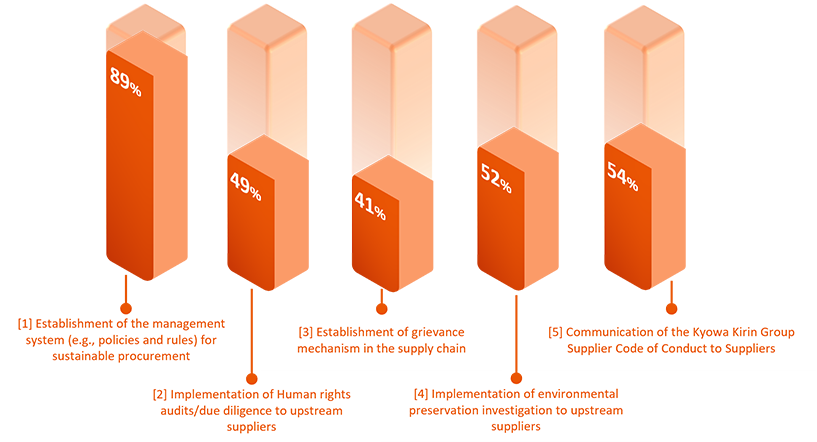
In particular, the survey results demonstrated year-on-year improvements, especially across items related to human rights and environmental preservation.
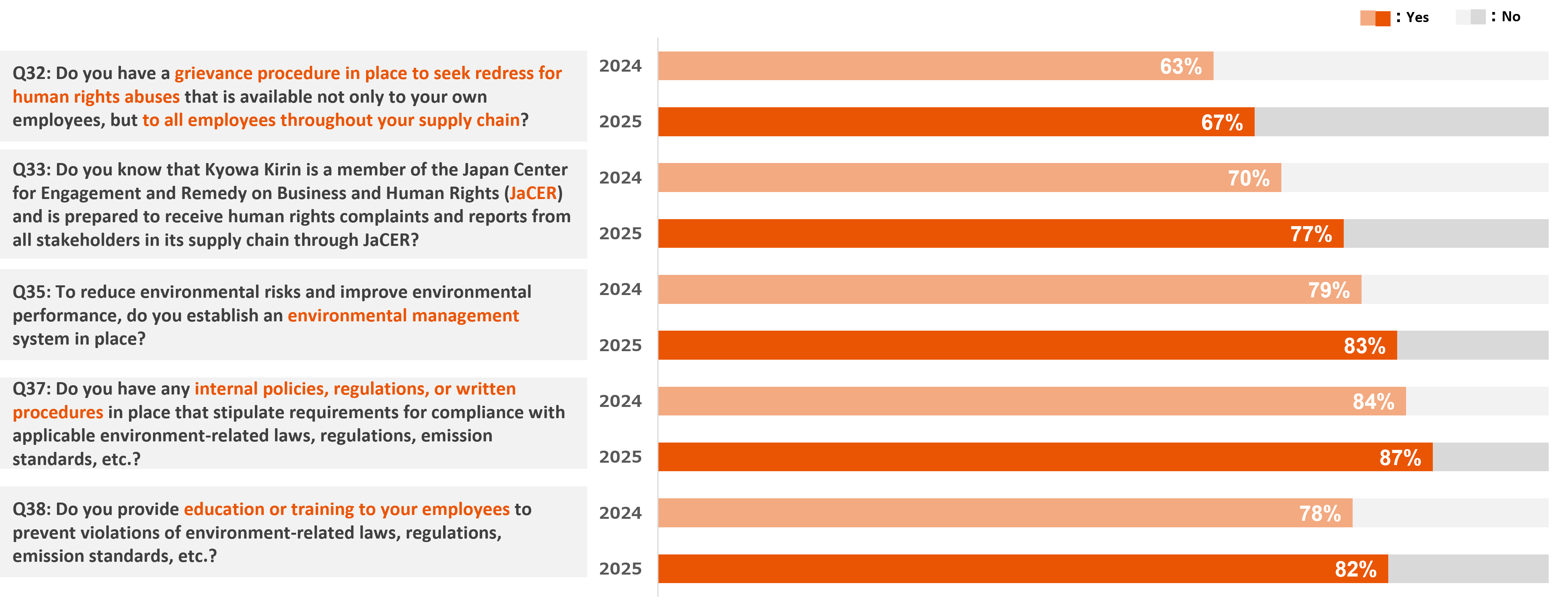
These improvements are the result of the continued efforts and initiatives undertaken by our suppliers to advance sustainable procurement within their own operations.
Promoting sustainable procurement requires ongoing and collaborative efforts across the entire supply chain. The Kyowa Kirin Group Supplier Code of Conduct, as well as the Group’s whistleblowing and Grievance Mechanism, including JaCER, are designed not only for the Group’s employees but also to be shared with and communicated throughout the supply chain, including secondary suppliers and other relevant business partners.
The Kyowa Kirin Group sincerely asks for continued cooperation in further promoting and strengthening initiatives related to sustainable procurement.
Supplier Briefings
We held a supplier briefing to share information on issues and solutions throughout the supply chain in 2018.
Adopting a webinar format, we held a supplier briefing in 2025. Based on the theme, “Toward the realization of sustainable procurement,” this briefing was attended by 145 companies.
This briefing was held as an opportunity to share details of our sustainable procurement policy and specific examples of initiatives with our suppliers and to discuss how to promote sustainable procurement, including respect for human rights and environmental conservation.
Human Rights Due Diligence
As our business continues to expand globally, the impact of our activities on rights holders around the world is becoming increasingly more far-reaching.
We believe that the creation of Life‑Changing Value requires co‑creation with our stakeholders. Based on this belief, we are committed to respecting human rights as part of our corporate social responsibility, with due consideration not only for our employees but also for all people involved across our business partners (including suppliers) and value chain.
In line with this approach, we have been implementing the following human rights due diligence initiatives for suppliers since 2022.
Please refer to the information below for further details on the Group’s initiatives related to human rights due diligence.