Index
New employees engage Kishida-san with diverse questions in an open dialogue
What can we do to bring smiles to those facing illness?
“Listen to the voices of those directly affected” – Embracing Kishida-san’s message
In April 2025, we invited Toru Kishida, Representative Director of the NPO Cancer Notes, to conduct training for our newly hired employees. Kyowa Kirin regularly hosts internal seminars where we listen to patients' stories; therefore, we created a similar opportunity for our new employees.
The goal of this training session was to help participants make Kyowa Kirin's vision their own. Tomoko Nakayama of the Corporate Communications Department’s Patient Advocacy Group, who organized the program, expressed, “I want you to use this opportunity to think about how to embody a patient-centric approach to addressing healthcare needs.” Let's explore the insights our new employees gained from their discussions with Kishida-san.
Guest Lecturer Profile
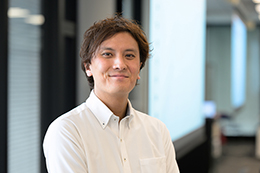
Mr. Toru Kishida
Born in Osaka Prefecture in 1987, he graduated from Ritsumeikan University. At the age of 25, he was diagnosed with embryonal carcinoma, a rare germ cell tumor, and underwent three months of chemotherapy and two surgeries. The cancer recurred approximately two years later, requiring additional surgery. He is currently under medical observation.
He serves in the Office of Public Relations, Strategic Planning Bureau of the National Cancer Center, and as a special lecturer at the Institute of Science Tokyo, as well as an external lecturer on cancer education for the Tokyo Metropolitan Government and other organizations. He also participates in the Ministry of Health, Labour and Welfare's cancer study group and subcommittee on cancer care.
Diagnosed with a rare cancer at 25 – Facing the burden of illness and the immense weight of life’s uncertainties
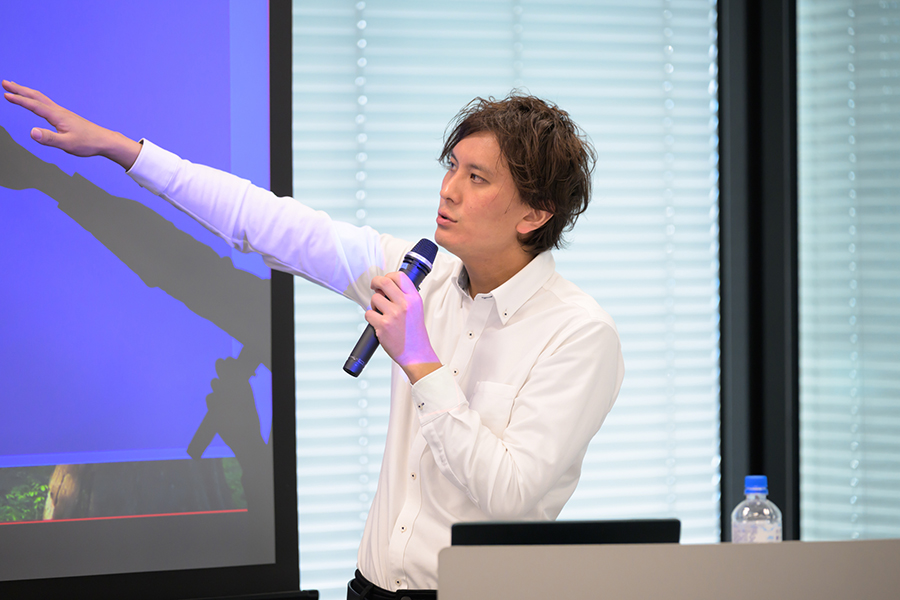
Kishida-san’s lecture began with a quiz, asking our new employees, “How many people are diagnosed with cancer in Japan each year?” He also posed the questions: “What percentage of cancer patients are of working age (20s to 60s)?” and “What percentage of patients resign or are dismissed from their jobs after a cancer diagnosis?”
He continued by inquiring, “Do you know about the AYA generation?” AYA stands for Adolescent and Young Adult, referring to patients aged 15 to 39. Having been diagnosed with cancer at the age of 25, Kishida-san himself belongs to this very generation—and is the same age as many of the new employees.
Kishida-san was diagnosed with a rare form of cancer during his second year as a working adult. Alongside the anxieties of hospitalization, surgery, and side effects from medication, he also faced deep concerns about money and returning to work after discharge. He recalled, “Before expensive medical tests, I sometimes ate only one meal a day,” illustrating just how great an impact illness can have on daily life.
Even as he spoke openly about his symptoms and emotions at the time, Kishida-san’s talk was filled with laughter. He emphasized the importance of humor, inspired by the words of a fellow patient he once met: “We don't smile because we're happy; we’re happy because we smile.” That patient’s commitment to maintain a smile even in harsh circumstances left a deep impression. Sharing this experience, Kishida-san encouraged the new employees: “There will be times when work life is tough. But in those moments, I hope you can smile, even just a little, and push through.”
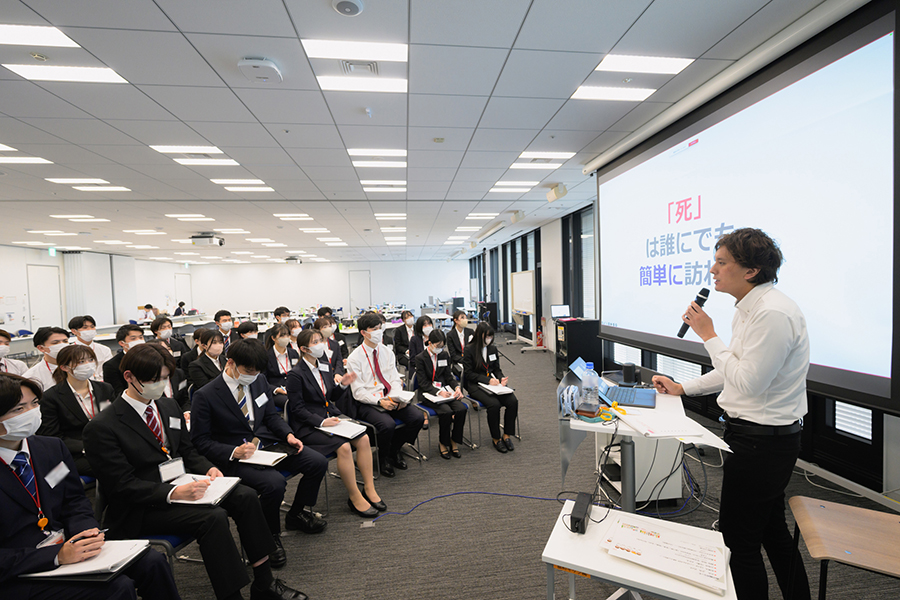
New employees engage Kishida-san with diverse questions in an open dialogue
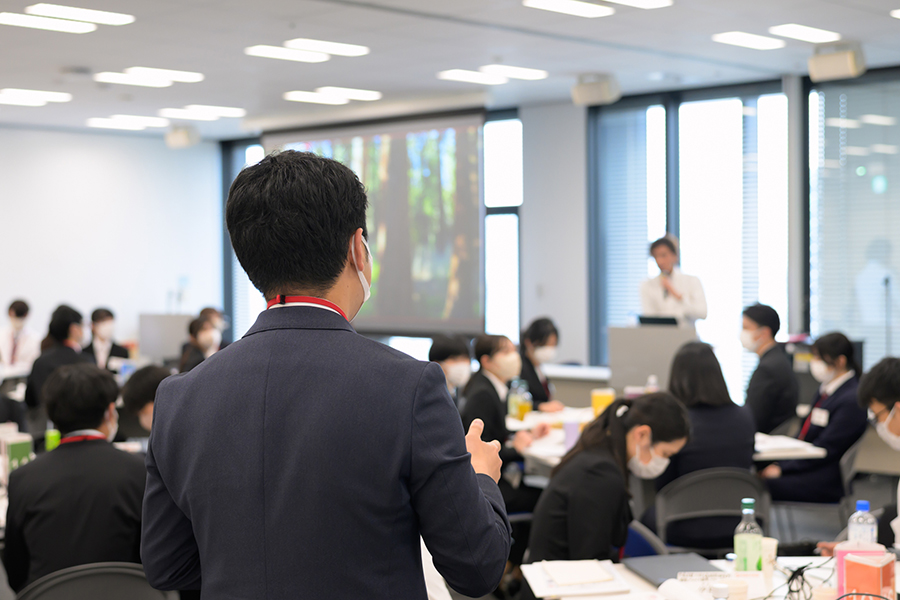
Following Kishida-san’s talk about his experiences with cancer treatment, the program shifted to group work. During this session, participants shared their impressions of the lecture and engaged in dialogue with Kishida-san, who answered questions one after the other from new employees.
─ What kind of information would you have wanted pharmaceutical companies to share?
Kishida (hereafter honorifics omitted) This is just my personal opinion, but as a patient, I want to know what kinds of symptoms others with the same illness experienced, and how it might progress. Since Kyowa Kirin has a nationwide network, I imagine you have access to a great deal of information. Even if it’s difficult to communicate directly with patients, passing along such information indirectly through healthcare professionals would be greatly appreciated.
─ Did you find it difficult to understand information about your medication? Were there any tools to help you understand anticancer drugs?
Kishida The pharmacist carefully explained the treatment plan using a printed schedule. I kept that paper close at hand, and it was convenient to look back on. Digital tools can also be practical, but since some patients can’t use them, I think hospitals often rely on paper-based explanations.
─ If someone close to us were diagnosed with cancer, how should we act around them?
Kishida When I interview people with cancer, most say they want those around them to treat them just as they always have. Personally, I really appreciated hearing, “If you ever need anything, just say so—I’ll be there for you.” Knowing they have someone to rely on brings real peace of mind when they’re undergoing treatment.
─ Did you ever feel a sense of kindness from healthcare providers during your treatment?
Kishida Absolutely. The medical professionals treated me very well throughout my treatment. It reminded me that healthcare is, at its core, about human-to-human relationships. I think the most important thing is to listen carefully to how the patient is feeling and thinking. Acting on your own assumptions, even intended as kindness, can sometimes backfire. For instance, young patients might be assigned younger healthcare providers under the assumption that it’ll put them at ease. But in some cases, being cared for by someone of the same generation makes the patient compare themselves to the providers and feel worse. That is why I believe it’s crucial to put the patient’s wishes at the center.
What can we do to bring smiles to those facing illness?
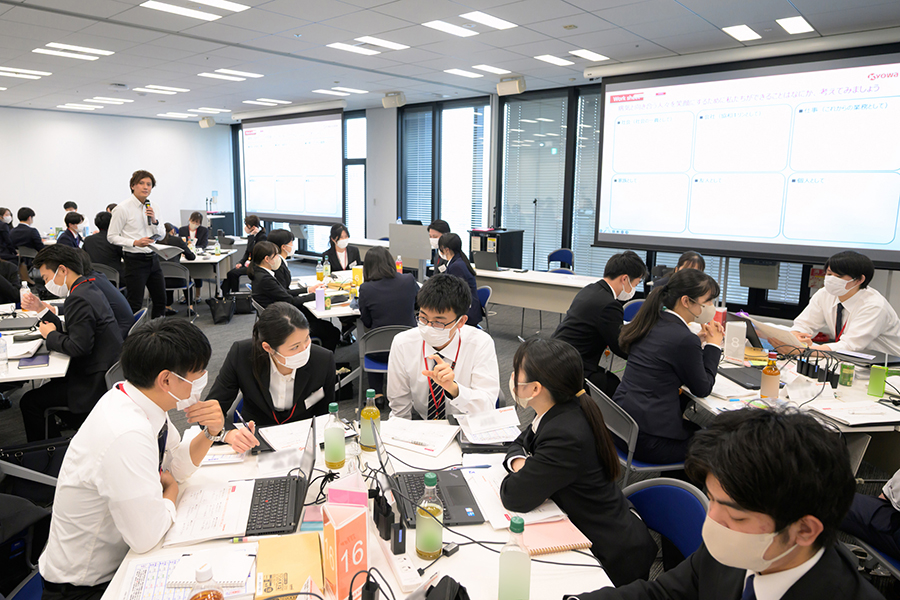
To go beyond merely understanding Kishida-san's talk and engage in a more personal reflection, a group exercise was organized with the theme: "What can we do to bring smiles to those facing illness?" Participants completed a worksheet that contained six sections labeled "Society," "Company," "Work," "Family," "Friends," and "Individual," and then shared their ideas with the group.
- Society (What I can do as a member of society)
- “I want to create a society where people don’t have to leave their jobs or schools because of illness. The loss of opportunities can be said to be “a side effect”. I want to support patients to help them live with their illnesses.”
- Company (What I can do as a member of Kyowa Kirin)
- “I think it’s important to uphold Kyowa Kirin’s KABEGOE Principles of ‘Make a Difference.’ Nothing changes if things remain as they are, so we need to always take on challenges.”
- Work (What I can do through my professional role)
- “As MRs, we are the final runners who deliver medicines on behalf of pharmaceutical companies. I want to communicate to healthcare professionals the dedication and passion of all those involved in developing the drug.”
“I aspire to contribute to the treatment of rare diseases. I want to identify difficult-to-treat cancers and undiscovered drug targets through my work.” - Family (What I can do as a family member)
- “I was moved by the story about how frightening it was to be alone during tough times. I want to educate myself about their illness and be present for them so that we can overcome the disease together.”
- Friends (What I can do as a friend)
- “I learned how encouraging it was to receive supportive messages. Expressing that support in a tangible way can give great courage, so I would like to offer support in various forms, like letters.”
- Individual (What I can do myself)
- I may be overly cautious and hesitate to ask patients about their needs. But it’s important to remember that living with illness involves not only patients or healthcare professionals, but requires society as a whole to be willing to listen. I want to hold on to that spirit.
Kishida-san's real-life experiences left a profound impression on the new employees, who are close in age to him. They thoughtfully considered what they could do and eagerly exchanged ideas.
“Listen to the voices of those directly affected” - Embracing Kishida-san’s message
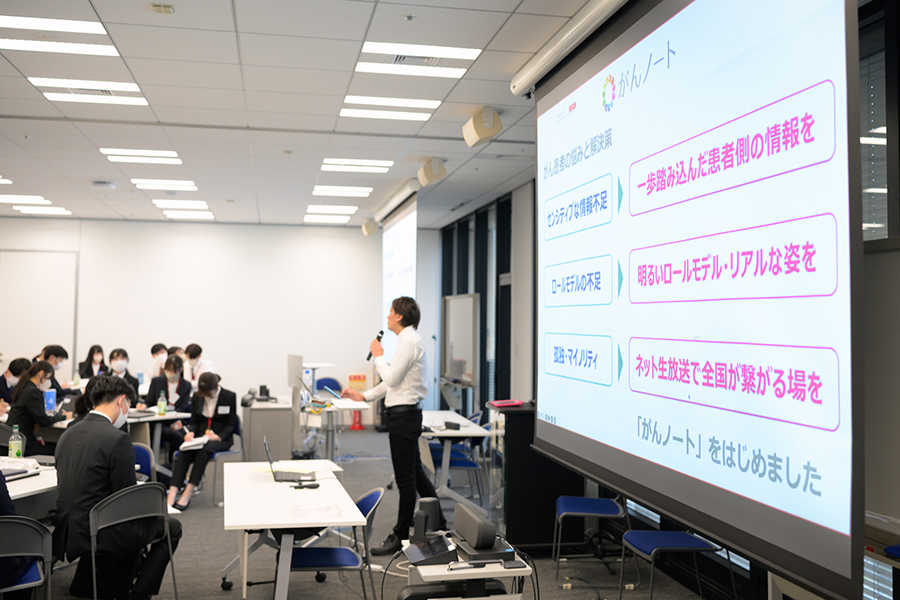
Having gone through his own battle with cancer, Kishida-san began to wonder what he could do as he was discharged from the hospital. Feeling that patients lacked access to real, practical information about daily life, he launched an initiative called Cancer Notes, in which he interviews cancer patients about their experiences and shares their stories through YouTube and a website. However, he gradually started to feel uncertain, wondering whether his efforts were merely serving as “self-satisfaction.”
To gain a new perspective, Kishida-san joined a social entrepreneurship program co-hosted by corporations and NPOs. There, he learned a vital lesson: the importance of asking those directly affected about the challenges they face.
He began by conducting a survey with cancer patients, which revealed that younger generations often sought information online but were dissatisfied with what they found. In addition, they also expressed a desire for information about life beyond treatment.
Convinced of the genuine need for Cancer Notes, Kishida-san resolved to continue. The project now provides a wide range of patient-driven information to cancer patients and their families, covering topics from family matters and work to relationships and marriage. To date, he has interviewed more than 400 people, and Cancer Notes’ YouTube channel has become a valuable source of information.
Reflecting on this experience, Kishida-san emphasizes, “Everything I want to share with you can be summed up as: Listen to the voices of those directly affected. While it is important to interact with medical professionals, it is equally important to hear from the patients themselves.”
He also offered words of encouragement to the new employees, stating, “For a company like Kyowa Kirin to provide opportunities in new-employee training to hear directly from patients is rare in the pharmaceutical industry. I hope you feel proud to be part of a company that strives to listen to patients’ voices.”
Never forgetting to listen to patients’ voices – Staying true to your original commitment in every workplace

The final workshop exercise was: “In your own words, express what you can do to bring smiles to patients, and write it down as a ‘pledge (declaration)’ to Kishida-san.” Each new employee recorded a personal commitment.
- “As an MR, I want to listen to patients' voices and always act with their perspectives in mind.”
- “I want to create a society where new technologies can be implemented quickly. To achieve this, it’s crucial to convey accurate information to non-specialists. I want to conduct research that leads to trustworthy medicines.”
- “Quality control testing is not just a task; it exists for the sake of patients. I pledge never to forget that.”
After hearing the new employees' resolutions, Kishida-san remarked, “What I wanted to emphasize throughout today was the importance of information. From now on, I hope you will actively seek out information and share it with others. And when you go out into the field, never forget to listen to the voices of patients. If you face obstacles in your work, I hope you will remember today.”
Finally, Nakayama from the Patient Advocacy Group added, “Pharmaceutical companies sometimes fall into the trap of thinking they ‘understand.’ But no two patients are the same. Listening to one person and feeling self-satisfied isn’t enough; what matters is your commitment to continuing to listen. That is the final message I want to leave you with.”
The following week, the new employees were assigned to their respective departments, carrying with them the lessons from the training as they embarked on their new roles.
When asked for his impressions, Kishida-san shared, “They really looked me in the eyes as they listened, and that gaze left an impression on me. During the workshops, many of them raised their hands, with a wide range speaking up, which gave me a sense of how positive the atmosphere was. They truly are a wonderful group.”
Reflections from the HR Training Office
One of the objectives of the new employee training program is to help participants internalize the company’s Philosophy, Vision, Core-Values, and KABEGOE Principles. Kishida-san’s talk, grounded in his personal experience, provided a valuable opportunity for them to think concretely about how their future work will connect to patients.
We in the HR Training Office were also deeply inspired by the sight of the new employees actively learning from Kishida-san and discovering a sense of meaning and pride in their own work.
To ensure that the insights gained in this program are not forgotten, we plan to create an opportunity one year from now for them to reflect once again on their thoughts toward patients, their approach to work, and their own growth—and to deliver those reflections as a message to Kishida-san.
Together with our new employees, united as one team, we will continue to uphold one of our Principles - “Patient Centric”- and strive to bring smiles to the faces of patients.
More Kyowa Kirin "Patients" Stories
Rare Disease Day 2025: Spreading Awareness and Support Holding Events Worldwide
Patients | August 29, 2025
Enhancing Patient-Centric Activities in Japan region’s Medical Affairs Department (MA Department): A Seminar with Guest Speakers, Including a Patient
Patients | August 19, 2025
Special Dialogue between the CEO & COO: Together, Pioneering New Horizons
Growth | July 24, 2025
“Healthcare Café” Report ─ A Platform for Patient Dialogue: Thinking About Hematopoietic Stem Cell Transplantation (Part One)
Patients | July 23, 2025
“Healthcare Café” Report ─ A Platform for Patient Dialogue: Thinking About Hematopoietic Stem Cell Transplantation (Part Two)
Patients | July 23, 2025
Special Discussion: Story for Vision 2030
Growth | June 23, 2025
PRIDE MONTH Message from Abdul Mullick, President and COO
People & Culture | June 2, 2025
Listening to Patients’ Voice and Responding to Their Needs: Kyowa Kirin's Patient Engagement Activities
Patients | March,18, 2025
Kyowa Kirin CPO Itagaki’s message for International Women’s Day
People & Culture | March 7, 2025
What is the Kyowa Kirin Group’s health and productivity management initiative, Wellness Action 2025?
People & Culture | February 10, 2025
Rare Disease Day 2025 - More Than You Can Imagine
Patients | February,7, 2025

Kyowa Kirin CEO Miyamoto’s New Year Message: Accelerate Our Reforms with Determination for Delivering Life-changing Value to Patients
Growth | January 14, 2025
Kyowa Kirin Hosted Booth at Tokyo Rainbow Pride 2024 for a Second Year in a Row: Initiatives for Accelerating DE&I and the Ideal State a Company Should Strive to Be (Part One)
People & Culture | October 15, 2024
Kyowa Kirin Hosted Booth at Tokyo Rainbow Pride 2024 for a Second Year in a Row: Initiatives for Accelerating DE&I and the Ideal State a Company Should Strive to Be (Part Two)
People & Culture | October 15, 2024
Strengthening our training framework to tackle the biopharmaceutical engineer shortage
People & Culture | September 20, 2024
Highlighting Kyowa Kirin's initiatives across regions for PRIDE MONTH 2024
People & Culture | September 13, 2024

Bio Adventure: Kyowa Kirin’s works with local communities on project to foster future scientists
People & Culture | August 9, 2024
PRIDE MONTH Message from Jeremy Morgan, President, Kyowa Kirin International plc (EMEA region)
People & Culture | July 5, 2024
Kyowa Kirin launches the CTCL Global Care Collaborative’s Time to Act global consensus statement
Patients | May 13, 2024
Kyowa Kirin Global Corporate Planning Head Shoko Itagaki’s Message for International Women's Day
People & Culture | March 8, 2024
Kyowa Kirin CEO Miyamoto’s New Year Message
Growth | January 9, 2024
Kyowa Kirin Chief International Business Officer Abdul Mullick’s Message on UN’s International Day of Persons with Disabilities
Sustainability | December 1, 2023
Kyowa Kirin hosted a booth for the first time at the Tokyo Rainbow Pride 2023 [Our Diversity, Equity & Inclusion]
People & Culture | November 9, 2023
Our Stable Supply of High-quality Pharmaceuticals
Sustainability | September 20, 2023

Provide pharmaceuticals for unmet medical needs - A Conversation with Kyowa Kirin’s R&D Executives
Innovation | August 22, 2023
Ensure a Thriving Global Environment for Future Generations
Sustainability | July 28, 2023

“Menstruation” and “fertility treatment” felt like taboo subjects in the workplace - Why be open about issues unique to women? PartⅡ
People & Culture | June 9, 2023
“Menstruation” and “fertility treatment” felt like taboo subjects in the workplace - Why be open about issues unique to women? PartⅠ
People & Culture | April 25, 2023
Kyowa Kirin CEO Miyamoto’s Message on Rare Disease Day
Patients | February 28, 2023
Promoting patient advocacy and nurturing patient-centric care: Interview with Kyowa Kirin North America
Patients | February 14, 2023

Celebrating another year of diverse initiatives around the world: RDD 2022 in EMEA
Patients | January 24, 2023

Celebrating another year of diverse initiatives around the world: RDD 2022 in North America
Patients | December 15, 2022

Celebrating another year of diverse initiatives around the world: RDD 2022 in Asia Pacific
Patients | November 21, 2022
Celebrating another year of diverse initiatives around the world: RDD 2022 in Japan
Patients | October 20, 2022
Providing high-quality pharmaceuticals to patients around the world
Sustainability | September 22, 2022
Striving to create life-changing “Only-one value” that brings smiles to patients
Innovation | July 25, 2022
Kyowa Kirin International: It's Time to Shine A Light on XLH
Patients | June 27, 2022
Kyowa Kirin CEO Miyamoto’s Message on Pride Month
People & Culture | June 9, 2022
Kyowa Kirin International Celebrates the UN’s International Day of Persons with Disabilities in EMEA
People & Culture | January 20, 2022

Kyowa Kirin International: Around the world challenge
People & Culture | December 17, 2021

Kyowa Kirin North America: Honoring The Caregiver, Everyday Heroes, During National Family Caregivers Month
Patients | November 19, 2021
Kyowa Kirin's Effort to Realize a Sustainable Society
Sustainability | October 11, 2021

Our Financial Strategy for Creating Life-changing Value
Growth | September 9, 2021
Changes in society caused by COVID-19 and the impact on Kyowa Kirin
Growth | August 19, 2021
Bio Adventure Hands-On Experience Sessions: Become a drug discovery researcher During Your Summer Break
Sustainability | July 27, 2021
AMGEN AND KYOWA KIRIN TO JOINTLY DEVELOP AND COMMERCIALIZE KHK4083, A PHASE 3-READY, POTENTIAL FIRST-IN-CLASS TREATMENT FOR ATOPIC DERMATITIS
News Release | June 1, 2021

MEI Pharma and Kyowa Kirin Announce New Clinical Data on Zandelisib at American Society of Clinical Oncology Annual Meeting
News Release | May 20, 2021

White Paper on the unrecognized burden of XLH in adults in Europe
Patients | July 13, 2020

Empowering Children to Ask "Why?": Tohoku University Science Campus Hands-On Science Lessons (First Half)
People & Culture | March 5, 2020
Empowering Children to Ask "Why?": Tohoku University Science Campus Hands-On Science Lessons (Second Half)
People & Culture | March 5, 2020
“Delivering smiles with sports” Creating an inclusive society through table tennis
Sustainability | January 14, 2020
Bio Adventure*: Kyowa Kirin Invites Children to a Science Adventure
People & Culture | July 3, 2019