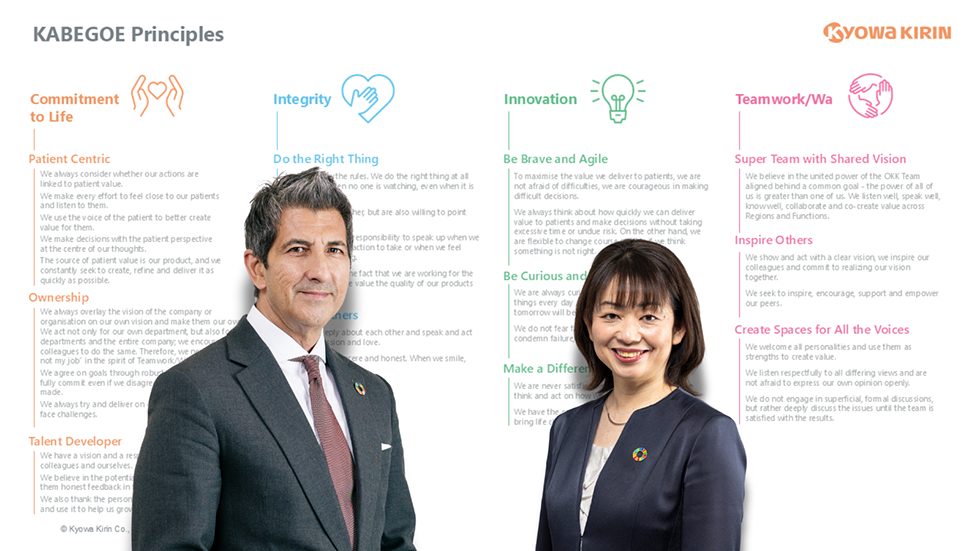
The "Strategy" and "Team" are the key elements for realizing Kyowa Kirin Group’s "Vision 2030." The Story for Vision 2030 was formulated in 2024 as a concrete strategy for achieving the vision. Similarly, regarding the "Team" necessary to promote the "Strategy" and realize the vision, building a team that bridges the gap between the ideal state of people and corporate culture and the current situation is required. To robustly drive the global strategy and continuously create life-changing value, the specific actions that each employee should take were articulated in the "KABEGOE Principles," established in 2025.
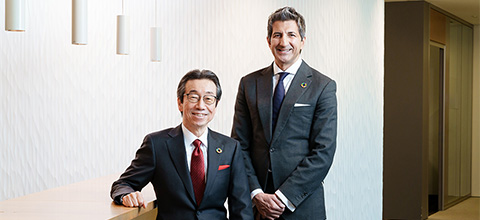
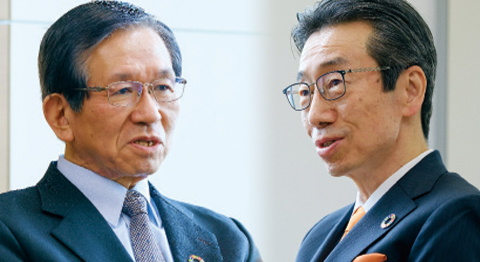
The KABEGOE Principles were created after extensive discussions among top management, considering the input and perspectives of all employees. Chief Operating Officer (COO) Abdul Mullick and Chief People Officer (CPO) Shoko Itagaki, who led the discussions, share the vision behind the principles, the process that led to their development, and the future they envision moving forward.
Supported by Our KABEGOE Culture and Commitment to Life
―Can you please tell us about the process that led to the formulation of the KABEGOE Principles?
Itagaki Our group is engaged in activities toward the realization of Vision 2030, which is to continuously create and deliver life-changing value that ultimately makes people smile. To make the realization of our vision more certain, we formulated the Story for Vision 2030 in 2024, followed by the KABEGOE Principles in 2025. These have been closely aligned with our key management issues (Materiality) and Annual Business Plans, and we are actively working to put them into practice.
We view talent as the source of our competitiveness and innovation. It was during our efforts to build and develop people and organizations based on this belief that the concept of KABEGOE emerged as a way to achieve our vision. The Corporate Culture Transformation Project, which originated from a thorough reflection on quality issues that occurred in 2019, we defined it ourselves as “stepping out of the comfort zone, embracing challenges, and overcoming barriers.”
KABEGOE is a concept that can become the source of our competitiveness by encouraging new challenges and value creation. We have been working to globally embed it as part of Kyowa Kirin Group’s corporate culture. In fact, employees overseas often speak about KABEGOE. This unique concept became the foundation for discussing the KABEGOE Principles.
Mullick Considering our business strategy, the development and retention of talent capable of demonstrating leadership on a global scale, as well as fostering a strong corporate culture, will become increasingly important. We view human capital as a vital element of management and are committed to addressing it with earnest. This is why the KABEGOE Principles were developed with significant enthusiasm and involvement from our top management. Discussions from the perspective of people and organizations can often be left to the Human Resources function, but under Itagaki-san’s facilitation, we seriously debated the necessary qualities of people and teams Kyowa Kirin seeks from the viewpoint of all CxOs and consolidated these into a concrete form.
We frequently revisited the core concept of “Commitment to Life” throughout the process. Commitment to Life was established through discussions among approximately 1,000 employees at the time of Kyowa Hakko Kirin’s (now Kyowa Kirin) founding in 2008, and it permeates everything from our philosophy to our employees’ actions. Likewise, Commitment to Life and other aspects of our history and DNA live on at the foundation of the KABEGOE Principles; they are not something created by “someone,” but rather something that has emerged from “ourselves.” Each item is equally important for achieving our vision, serving as a guideline for everyone at Kyowa Kirin, from new employees to the CEO, in their daily actions and decisions.
The 11 KABEGOE Principles
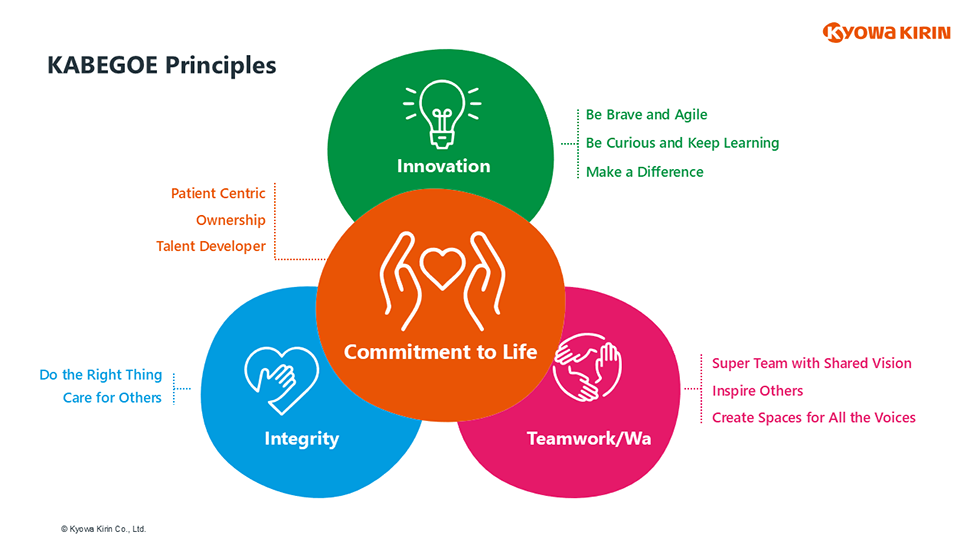
―What are the specific contents of the KABEGOE Principles?
Itagaki The KABEGOE Principles outline how we at Kyowa Kirin work together, drive transformation, and collectively grow to achieve our vision and pursue further growth beyond it. There is a total of 11 principles, and by each of us embodying them continuously, we will shape and strengthen our KABEGOE Culture.
―Is there an example of action related to principles
Mullick All the principles are important. but I would like to share my thought on “Super Team with Shared Vision.” We have developed some super-strong vertical teams, global functions, and geographies. To truly achieve what we aspire to, it will only happen when we stand together, shoulder to shoulder, aligned behind a common set of goals, bringing our maximum power to achieve them.
Itagaki While it is important to embody all principles, I will talk about “Ownership.” This principle embodies the key qualities for enterprise leaders, one model of leadership for the coming era, who are essential for realizing our Story for Vision 2030. It means acting not only for one’s own department but also for other departments and for the entire Group. In the spirit of Teamwork/Wa, we never say, “That’s not my job.” I believe this kind of leadership is what we need, and I personally strive to demonstrate it. I also hope that everyone working at Kyowa Kirin will do the same.
The Future We Aim to Realize Through the KABEGOE Principles
―What kind of company do you want Kyowa Kirin to become through the practice of the KABEGOE Principles?
Itagaki In today’s rapidly changing business environment, I believe the KABEGOE Principles will serve as our compass as we reassess what we should do to continuously deliver life-changing value, what our teams and organizations should look like, and how to achieve these goals. We encourage the development of mindsets and the establishment of an environment that empowers frontline leaders to illustrate their own aspirations for achieving our vision for the Company and organization from the standpoint of the Strategy and Team, act autonomously in response to change, and accelerate growth for themselves and those around them. As part of these efforts, we have embedded mechanisms into our global performance management system that allow employees worldwide to refer back to the KABEGOE Principles when setting goals and evaluating actions. We are also incorporating the KABEGOE Principles into the processes for discovering and developing the talent who will lead our Group globally in the future. By continuously operating these systems and maintaining open communication with employees, we aim to foster an environment in which each individual’s practice of the KABEGOE Principles directly contributes to strengthening our corporate competitiveness.
Mullick I am one of those who was deeply impressed by Commitment to Life. I still vividly remember the first time I saw it—how moved I was, how strongly it resonated with me, and how genuinely excited I felt to work together with wonderful colleagues who share this aspiration to make a difference for “the one and only life.”
I am also very fond of the KABEGOE Principles, that is rooted in this spirit. These principles are something that all of us working across our global group want to practice equally. Each one represents an action we should take to continue growing and delivering value to patients and everyone involved. By sincerely practicing each one of these principles every day, we will cultivate the KABEGOE Culture we aspire to. And I believe this will enable the creation of teams that can powerfully execute our Story for Vision 2030, and realize our vision, ultimately leading to smiles for everyone facing illness.
In order to continue creating and providing value as a Japan-based Global Specialty Pharmaceutical company in the true meaning of the term, and as a member of top management, I will communicate the KABEGOE Principles to our colleagues worldwide, encouraging them to continue putting these principles into action.
More Kyowa Kirin "People & Culture" Stories
Rare Disease Day 2025: Spreading Awareness and Support Holding Events Worldwide
Patients | August 29, 2025

Enhancing Patient-Centric Activities in Japan region’s Medical Affairs Department (MA Department): A Seminar with Guest Speakers, Including a Patient
Patients | August 19, 2025
Special Dialogue between the CEO & COO: Together, Pioneering New Horizons
Growth | July 24, 2025
“Healthcare Café” Report ─ A Platform for Patient Dialogue: Thinking About Hematopoietic Stem Cell Transplantation (Part One)
Patients | July 23, 2025

“Healthcare Café” Report ─ A Platform for Patient Dialogue: Thinking About Hematopoietic Stem Cell Transplantation (Part Two)
Patients | July 23, 2025

Special Discussion: Story for Vision 2030
Growth | June 23, 2025
PRIDE MONTH Message from Abdul Mullick, President and COO
People & Culture | June 2, 2025

Listening to Patients’ Voice and Responding to Their Needs: Kyowa Kirin's Patient Engagement Activities
Patients | March,18, 2025
Kyowa Kirin CPO Itagaki’s message for International Women’s Day
People & Culture | March 7, 2025
What is the Kyowa Kirin Group’s health and productivity management initiative, Wellness Action 2025?
People & Culture | February 10, 2025
Rare Disease Day 2025 - More Than You Can Imagine
Patients | February,7, 2025

Kyowa Kirin CEO Miyamoto’s New Year Message: Accelerate Our Reforms with Determination for Delivering Life-changing Value to Patients
Growth | January 14, 2025
Kyowa Kirin Hosted Booth at Tokyo Rainbow Pride 2024 for a Second Year in a Row: Initiatives for Accelerating DE&I and the Ideal State a Company Should Strive to Be (Part One)
People & Culture | October 15, 2024
Kyowa Kirin Hosted Booth at Tokyo Rainbow Pride 2024 for a Second Year in a Row: Initiatives for Accelerating DE&I and the Ideal State a Company Should Strive to Be (Part Two)
People & Culture | October 15, 2024
Strengthening our training framework to tackle the biopharmaceutical engineer shortage
People & Culture | September 20, 2024
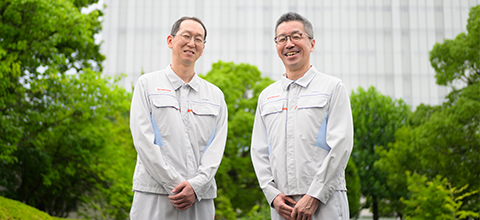
Highlighting Kyowa Kirin's initiatives across regions for PRIDE MONTH 2024
People & Culture | September 13, 2024

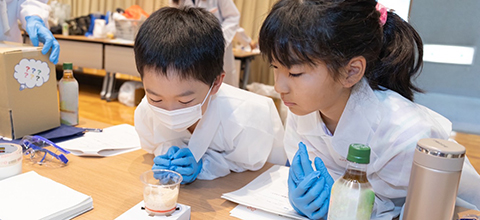
Bio Adventure: Kyowa Kirin’s works with local communities on project to foster future scientists
People & Culture | August 9, 2024
PRIDE MONTH Message from Jeremy Morgan, President, Kyowa Kirin International plc (EMEA region)
People & Culture | July 5, 2024
Kyowa Kirin launches the CTCL Global Care Collaborative’s Time to Act global consensus statement
Patients | May 13, 2024

Kyowa Kirin Global Corporate Planning Head Shoko Itagaki’s Message for International Women's Day
People & Culture | March 8, 2024

Kyowa Kirin CEO Miyamoto’s New Year Message
Growth | January 9, 2024
Kyowa Kirin Chief International Business Officer Abdul Mullick’s Message on UN’s International Day of Persons with Disabilities
Sustainability | December 1, 2023
Kyowa Kirin hosted a booth for the first time at the Tokyo Rainbow Pride 2023 [Our Diversity, Equity & Inclusion]
People & Culture | November 9, 2023
Our Stable Supply of High-quality Pharmaceuticals
Sustainability | September 20, 2023

Provide pharmaceuticals for unmet medical needs - A Conversation with Kyowa Kirin’s R&D Executives
Innovation | August 22, 2023
Ensure a Thriving Global Environment for Future Generations
Sustainability | July 28, 2023

“Menstruation” and “fertility treatment” felt like taboo subjects in the workplace - Why be open about issues unique to women? PartⅡ
People & Culture | June 9, 2023
“Menstruation” and “fertility treatment” felt like taboo subjects in the workplace - Why be open about issues unique to women? PartⅠ
People & Culture | April 25, 2023
Kyowa Kirin CEO Miyamoto’s Message on Rare Disease Day
Patients | February 28, 2023
Promoting patient advocacy and nurturing patient-centric care: Interview with Kyowa Kirin North America
Patients | February 14, 2023

Celebrating another year of diverse initiatives around the world: RDD 2022 in EMEA
Patients | January 24, 2023

Celebrating another year of diverse initiatives around the world: RDD 2022 in North America
Patients | December 15, 2022

Celebrating another year of diverse initiatives around the world: RDD 2022 in Asia Pacific
Patients | November 21, 2022

Celebrating another year of diverse initiatives around the world: RDD 2022 in Japan
Patients | October 20, 2022
Providing high-quality pharmaceuticals to patients around the world
Sustainability | September 22, 2022
Striving to create life-changing “Only-one value” that brings smiles to patients
Innovation | July 25, 2022
Kyowa Kirin International: It's Time to Shine A Light on XLH
Patients | June 27, 2022

Kyowa Kirin CEO Miyamoto’s Message on Pride Month
People & Culture | June 9, 2022
Kyowa Kirin International Celebrates the UN’s International Day of Persons with Disabilities in EMEA
People & Culture | January 20, 2022

Kyowa Kirin International: Around the world challenge
People & Culture | December 17, 2021

Kyowa Kirin North America: Honoring The Caregiver, Everyday Heroes, During National Family Caregivers Month
Patients | November 19, 2021

Kyowa Kirin's Effort to Realize a Sustainable Society
Sustainability | October 11, 2021

Our Financial Strategy for Creating Life-changing Value
Growth | September 9, 2021
Changes in society caused by COVID-19 and the impact on Kyowa Kirin
Growth | August 19, 2021
Bio Adventure Hands-On Experience Sessions: Become a drug discovery researcher During Your Summer Break
Sustainability | July 27, 2021
AMGEN AND KYOWA KIRIN TO JOINTLY DEVELOP AND COMMERCIALIZE KHK4083, A PHASE 3-READY, POTENTIAL FIRST-IN-CLASS TREATMENT FOR ATOPIC DERMATITIS
News Release | June 1, 2021

MEI Pharma and Kyowa Kirin Announce New Clinical Data on Zandelisib at American Society of Clinical Oncology Annual Meeting
News Release | May 20, 2021

White Paper on the unrecognized burden of XLH in adults in Europe
Patients | July 13, 2020

Empowering Children to Ask "Why?": Tohoku University Science Campus Hands-On Science Lessons (First Half)
People & Culture | March 5, 2020
Empowering Children to Ask "Why?": Tohoku University Science Campus Hands-On Science Lessons (Second Half)
People & Culture | March 5, 2020
“Delivering smiles with sports” Creating an inclusive society through table tennis
Sustainability | January 14, 2020
Bio Adventure*: Kyowa Kirin Invites Children to a Science Adventure
People & Culture | July 3, 2019