Index
An environment that encourages bold drug discovery – taking on challenges without fear of failure
Leveraging DX and diversity to continuously refine experiments
The Innovation Center at Kyowa Kirin is a research institute dedicated to advancing early-stage drug discovery. Research is led by Principal Investigators (PIs), experts in their respective scientific fields, who guide teams that collaborate flexibly across teams while pursuing individual research themes.
In Part 2 of this article, the focus shifts to mechanisms that encourage the emergence of new ideas and to team management approaches that promote innovation.
“When it comes to this research, that’s the person.” – nurturing the strengths of each individual researcher
─ You mentioned that research themes are generated bottom-up. With 11 teams and researchers from diverse backgrounds at the Innovation Center, do people know what the others are working on?
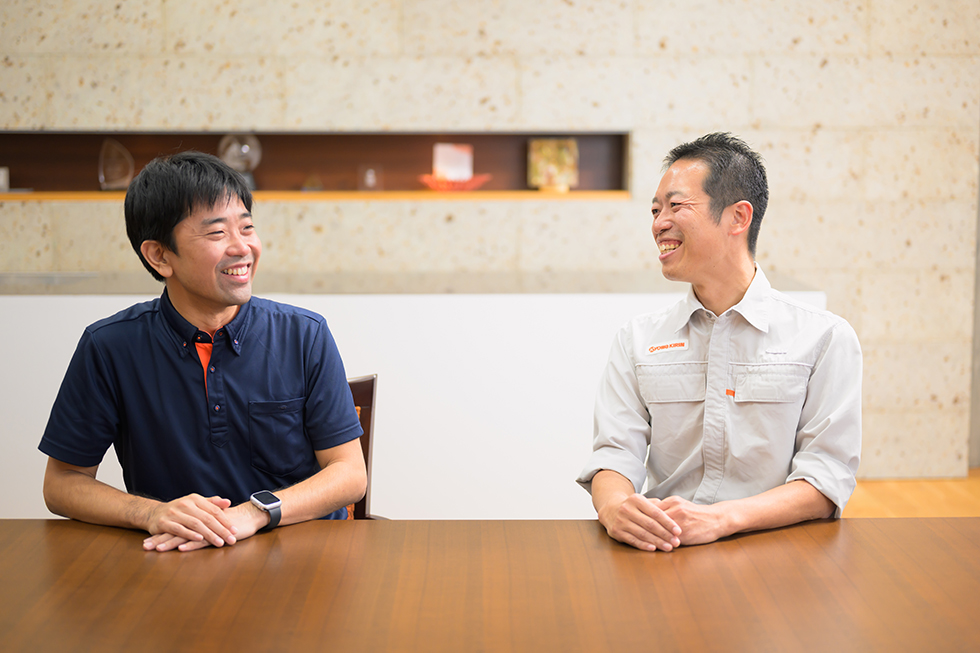
Usami We deliberately create opportunities for interaction to foster new ideas. One example is the research poster presentation sessions held within the Innovation Center. Many of the presenters are early-career researchers who introduce research topics 'they are now doing or keen to do'. I think these sessions serve as a valuable opportunity for researchers to learn about each other’s interests and areas of expertise.
Esaki In addition, I think we have a structure that allows people to connect naturally, without having to make a special effort. All 11 PIs are genuinely interested in people, and each of them knows a great deal about a wide range of researchers.
Usami That’s true. When someone asks a question, we often say, “So-and-so has been working on something related. Why don’t you talk to them?” The PIs really have extensive networks, which are always impressive.
Esaki It’s also important for researchers themselves to make an effort to share what they are working on. There’s a saying in Japanese that “the nail that sticks out gets hammered down,” but I believe that the nail that sticks out should be encouraged to grow. I want everyone to become that “outstanding nail.”
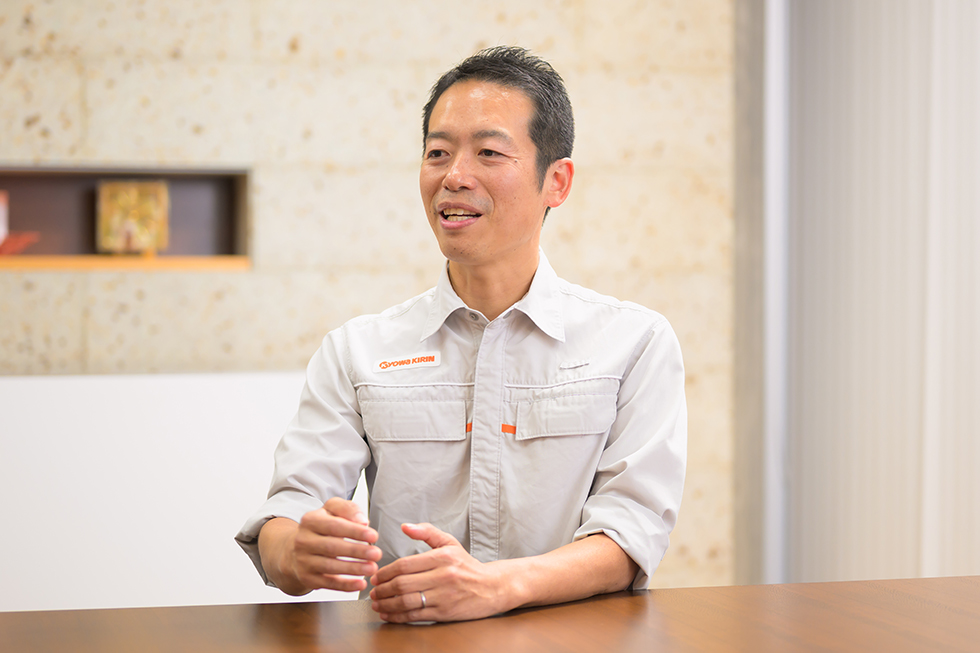
Usami One thing PIs can do is help create a “professional poster” for researchers. When others can say, “If it’s this research, that’s the person,” communication becomes much easier.
Esaki Exactly. And in addition to a professional poster, a “personality poster” is just as important.
Usami How someone wants to be known within the organization really depends on the individual. Some people want to be in the spotlight, while others prefer to contribute behind the scenes. When supporting researchers, I think it’s important to tailor our approach to each person. Speaking of understanding personalities, your team played a card game, didn’t they?
Esaki Yes, we did. When the team was first formed, many of us were working together for the first time, so I was thinking about how to break the ice. I asked the team for ideas, and someone suggested a card game, so we decided to play poker. It revealed people’s personalities more than I expected. Not only did it help us get to know each other, but it also created an atmosphere where people felt free to spend time thinking about new ideas, which was exactly what we were hoping for.
Usami Most of my team members are the same people I worked with back when we were in the modality-focused research group, but my role has changed. I told them honestly that there are limits to what I can do, so please help with the things I can’t or haven’t been able to. Their support has been invaluable, and I think openly sharing what’s missing is a healthy way for a team to function.
Esaki If you don’t really know someone, it’s hard to judge how far you can go when giving feedback. The card game helped, but we also try to structure work so that it isn’t always one person per theme. Sometimes two people share one theme, or two people handle three themes together. That way, people get to know more colleagues, share expertise, and support one another. Lately, I’ve been getting more feedback from the team myself. I get comments like, “Esaki-san, that’s not okay!” So the number of call-outs has definitely increased (laughs).
Usami That means you’ve built a relationship where people feel comfortable speaking up.
Esaki I’d like to become someone who doesn’t need to be called out at all, though.
An environment that encourages bold drug discovery – taking on challenges without fear of failure
─ What do you value most when it comes to team management?
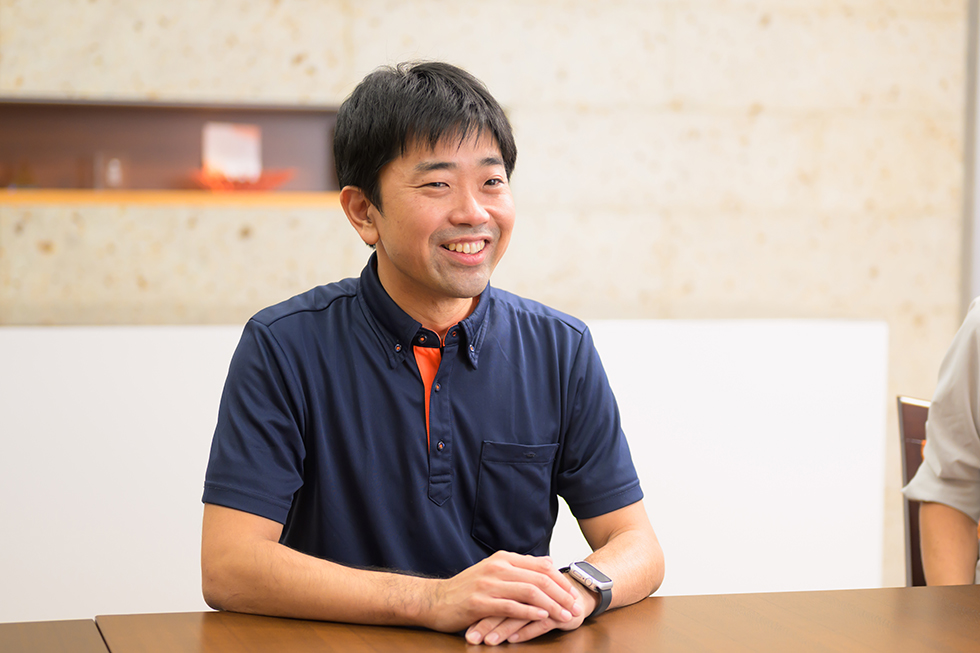
Usami I encourage people to think not only about the themes they are directly responsible for, but also about their colleagues’ themes as their own. If they notice something and think, “This might work better,” I want them to speak up. The reason is simple: the number of themes one person can personally handle is limited, but by engaging with others’ work, you gain far more experience.
I want to highlight the importance of taking action rather than just engaging in discussions. Sometimes, endless meetings lead to no clear conclusions. In such situations, it's often quicker to conduct an experiment and analyze the results. Even if the outcome isn’t what you expected, you gain valuable insights into the problem, which can be applied to your next attempt. I encourage teams to continually repeat this cycle.
Esaki What I value most is giving people a push forward. If someone wants to try something, I want them to do it at about three times the scale they originally had in mind. Many people tend to hold back. Because early-stage discovery involves frequent failure, researchers sometimes hesitate, wondering, “Is it okay to try this?” or “What if it doesn’t work?”
That’s exactly why my role is to foster an environment where, if someone wants to explore 10 possibilities, they can actually test 30. Less experienced researchers tend to think, “This is probably all I can manage,” leading them to narrow their ideas from 10 down to just three. But we can support each other as a team, and we also have tools like robotics at our disposal. With a bit of creativity, there's always a way forward.
Usami First and foremost, it’s important not to label things as failures. Every experience leads to the next opportunity. Even if a particular theme doesn’t succeed, it doesn’t mean that the individual has failed; it’s simply a result of experimentation. I want people to feel free to work without unnecessary pressure.
Esaki I completely agree. If you try three different approaches, perhaps one will succeed. While some methods may seem inefficient from a purely theoretical perspective, that’s exactly what I want to encourage. Rather than spending time ranking priorities from 1 to 10, I prefer to focus on exploring options from 1 to 30. I always remind the team, “You have the right to take on challenges.”
Usami Since we’re fortunate enough to work in an industrial research environment, I want people to truly appreciate that they can take on challenges.
Esaki Exactly. I want them to go all in.
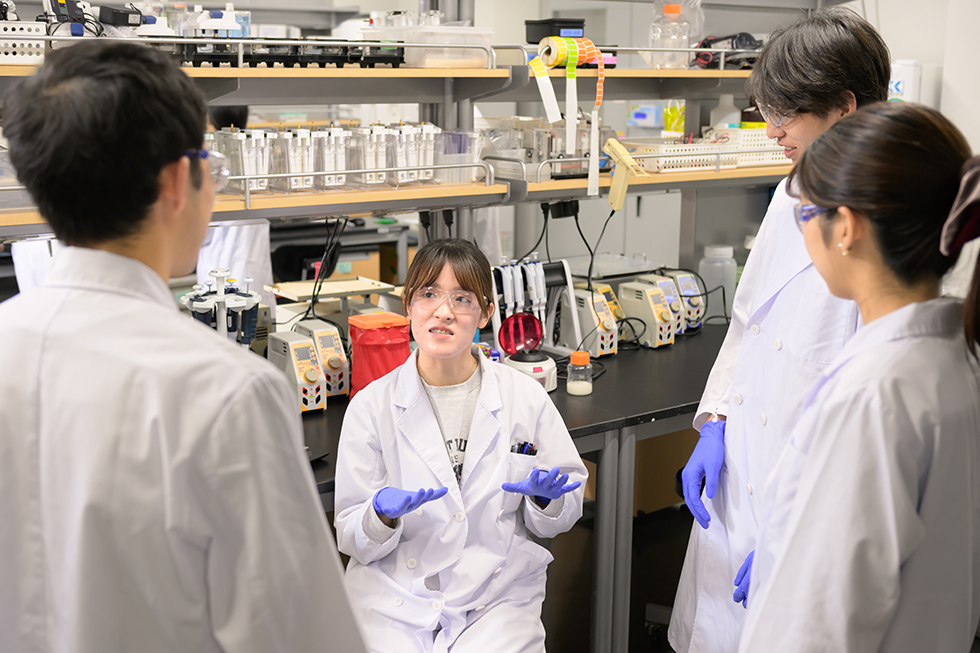
Leveraging DX and diversity to continuously refine experiments
─ With all of this, doesn’t the work get extremely busy?
Esaki It does get busy. Sometimes it feels overwhelming. That said, it doesn’t necessarily translate into excessively long working hours.
Usami Many researchers adjust their working hours flexibly based on the progress and schedule of their research goals. Everyone seeks ways to work more efficiently, creating an environment that demands strong self-management skills. At the same time, this level of autonomy makes it easier to balance work and personal life.
In my case, my spouse and I both work, so I sometimes leave early for family reasons. We can also leverage other teams’ experimental results or bring in specialists when needed. I want team members to think about how something can be made possible, rather than assuming it can’t be done.
Esaki For example, there are ways to automate analysis through programming. As a company, we are actively promoting DX by leveraging tools such as robotics and AI to find effective ways forward.
Usami DX certainly helps. At the same time, relying on DX alone without actually running experiments isn’t ideal either. At the Innovation Center, we work under the slogan “Back to the Labs.” There are things you simply can’t understand without experimenting. I truly hope researchers will make full use of DX while remaining deeply engaged in hands-on experimentation.
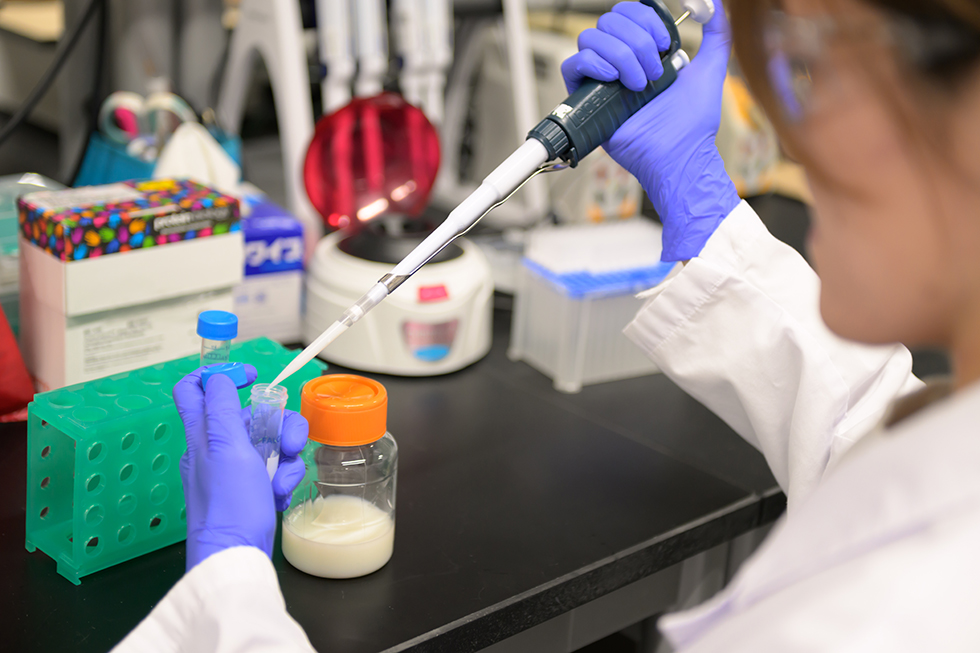
─ Researchers at the Innovation Center also have opportunities to attend international conferences, correct?
Usami In recent years, there have been more on-demand and virtual options, but we believe there are things you can only truly experience in person. The Center Director actively encourages participation in international conferences because they want researchers to experience global developments firsthand.
In addition, studying abroad requires a doctoral degree, so some people are inspired by the stimulation they receive at international conferences and begin to consider pursuing a PhD as part of their career development.
Esaki Our competitors—and our partners—are global. You can’t compete if you don’t understand the world. I see participation in international conferences as a message to researchers: Understand the global landscape, conduct science that can truly compete, and pursue rigorous, credible research.
─ Finally, could you share your outlook for the future?
Usami I believe that any medicine we develop must be something we would feel safe administering to ourselves if we were patients. If a drug incorporating technology I helped create ultimately reaches patients, there could be no greater fulfillment as a researcher.
Esaki I feel the same way. I want to help create products that become pillars of the company and to deliver medicines originating in Japan to patients around the world. I believe that our efforts today contribute not only to the growth of the pharmaceutical industry in Japan but also to a future in which the next generation can thrive.
More Kyowa Kirin "Innovation" Stories
Rare Disease Day 2025: Spreading Awareness and Support Holding Events Worldwide
Patients | August 29, 2025

Enhancing Patient-Centric Activities in Japan region’s Medical Affairs Department (MA Department): A Seminar with Guest Speakers, Including a Patient
Patients | August 19, 2025
Special Dialogue between the CEO & COO: Together, Pioneering New Horizons
Growth | July 24, 2025
“Healthcare Café” Report ─ A Platform for Patient Dialogue: Thinking About Hematopoietic Stem Cell Transplantation (Part One)
Patients | July 23, 2025
“Healthcare Café” Report ─ A Platform for Patient Dialogue: Thinking About Hematopoietic Stem Cell Transplantation (Part Two)
Patients | July 23, 2025
Special Discussion: Story for Vision 2030
Growth | June 23, 2025
PRIDE MONTH Message from Abdul Mullick, President and COO
People & Culture | June 2, 2025
Listening to Patients’ Voice and Responding to Their Needs: Kyowa Kirin's Patient Engagement Activities
Patients | March,18, 2025
Kyowa Kirin CPO Itagaki’s message for International Women’s Day
People & Culture | March 7, 2025
What is the Kyowa Kirin Group’s health and productivity management initiative, Wellness Action 2025?
People & Culture | February 10, 2025
Rare Disease Day 2025 - More Than You Can Imagine
Patients | February,7, 2025

Kyowa Kirin CEO Miyamoto’s New Year Message: Accelerate Our Reforms with Determination for Delivering Life-changing Value to Patients
Growth | January 14, 2025
Kyowa Kirin Hosted Booth at Tokyo Rainbow Pride 2024 for a Second Year in a Row: Initiatives for Accelerating DE&I and the Ideal State a Company Should Strive to Be (Part One)
People & Culture | October 15, 2024
Kyowa Kirin Hosted Booth at Tokyo Rainbow Pride 2024 for a Second Year in a Row: Initiatives for Accelerating DE&I and the Ideal State a Company Should Strive to Be (Part Two)
People & Culture | October 15, 2024
Strengthening our training framework to tackle the biopharmaceutical engineer shortage
People & Culture | September 20, 2024
Highlighting Kyowa Kirin's initiatives across regions for PRIDE MONTH 2024
People & Culture | September 13, 2024

Bio Adventure: Kyowa Kirin’s works with local communities on project to foster future scientists
People & Culture | August 9, 2024
PRIDE MONTH Message from Jeremy Morgan, President, Kyowa Kirin International plc (EMEA region)
People & Culture | July 5, 2024
Kyowa Kirin launches the CTCL Global Care Collaborative’s Time to Act global consensus statement
Patients | May 13, 2024
Kyowa Kirin Global Corporate Planning Head Shoko Itagaki’s Message for International Women's Day
People & Culture | March 8, 2024

Kyowa Kirin CEO Miyamoto’s New Year Message
Growth | January 9, 2024
Kyowa Kirin Chief International Business Officer Abdul Mullick’s Message on UN’s International Day of Persons with Disabilities
Sustainability | December 1, 2023
Kyowa Kirin hosted a booth for the first time at the Tokyo Rainbow Pride 2023 [Our Diversity, Equity & Inclusion]
People & Culture | November 9, 2023
Our Stable Supply of High-quality Pharmaceuticals
Sustainability | September 20, 2023
Provide pharmaceuticals for unmet medical needs - A Conversation with Kyowa Kirin’s R&D Executives
Innovation | August 22, 2023
Ensure a Thriving Global Environment for Future Generations
Sustainability | July 28, 2023

“Menstruation” and “fertility treatment” felt like taboo subjects in the workplace - Why be open about issues unique to women? PartⅡ
People & Culture | June 9, 2023
“Menstruation” and “fertility treatment” felt like taboo subjects in the workplace - Why be open about issues unique to women? PartⅠ
People & Culture | April 25, 2023
Kyowa Kirin CEO Miyamoto’s Message on Rare Disease Day
Patients | February 28, 2023
Promoting patient advocacy and nurturing patient-centric care: Interview with Kyowa Kirin North America
Patients | February 14, 2023
Celebrating another year of diverse initiatives around the world: RDD 2022 in EMEA
Patients | January 24, 2023

Celebrating another year of diverse initiatives around the world: RDD 2022 in North America
Patients | December 15, 2022

Celebrating another year of diverse initiatives around the world: RDD 2022 in Asia Pacific
Patients | November 21, 2022
Celebrating another year of diverse initiatives around the world: RDD 2022 in Japan
Patients | October 20, 2022
Providing high-quality pharmaceuticals to patients around the world
Sustainability | September 22, 2022
Striving to create life-changing “Only-one value” that brings smiles to patients
Innovation | July 25, 2022
Kyowa Kirin International: It's Time to Shine A Light on XLH
Patients | June 27, 2022
Kyowa Kirin CEO Miyamoto’s Message on Pride Month
People & Culture | June 9, 2022
Kyowa Kirin International Celebrates the UN’s International Day of Persons with Disabilities in EMEA
People & Culture | January 20, 2022

Kyowa Kirin International: Around the world challenge
People & Culture | December 17, 2021
Kyowa Kirin North America: Honoring The Caregiver, Everyday Heroes, During National Family Caregivers Month
Patients | November 19, 2021
Kyowa Kirin's Effort to Realize a Sustainable Society
Sustainability | October 11, 2021
Our Financial Strategy for Creating Life-changing Value
Growth | September 9, 2021
Changes in society caused by COVID-19 and the impact on Kyowa Kirin
Growth | August 19, 2021
Bio Adventure Hands-On Experience Sessions: Become a drug discovery researcher During Your Summer Break
Sustainability | July 27, 2021
AMGEN AND KYOWA KIRIN TO JOINTLY DEVELOP AND COMMERCIALIZE KHK4083, A PHASE 3-READY, POTENTIAL FIRST-IN-CLASS TREATMENT FOR ATOPIC DERMATITIS
News Release | June 1, 2021

MEI Pharma and Kyowa Kirin Announce New Clinical Data on Zandelisib at American Society of Clinical Oncology Annual Meeting
News Release | May 20, 2021

White Paper on the unrecognized burden of XLH in adults in Europe
Patients | July 13, 2020

Empowering Children to Ask "Why?": Tohoku University Science Campus Hands-On Science Lessons (First Half)
People & Culture | March 5, 2020
Empowering Children to Ask "Why?": Tohoku University Science Campus Hands-On Science Lessons (Second Half)
People & Culture | March 5, 2020
“Delivering smiles with sports” Creating an inclusive society through table tennis
Sustainability | January 14, 2020
Bio Adventure*: Kyowa Kirin Invites Children to a Science Adventure
People & Culture | July 3, 2019